
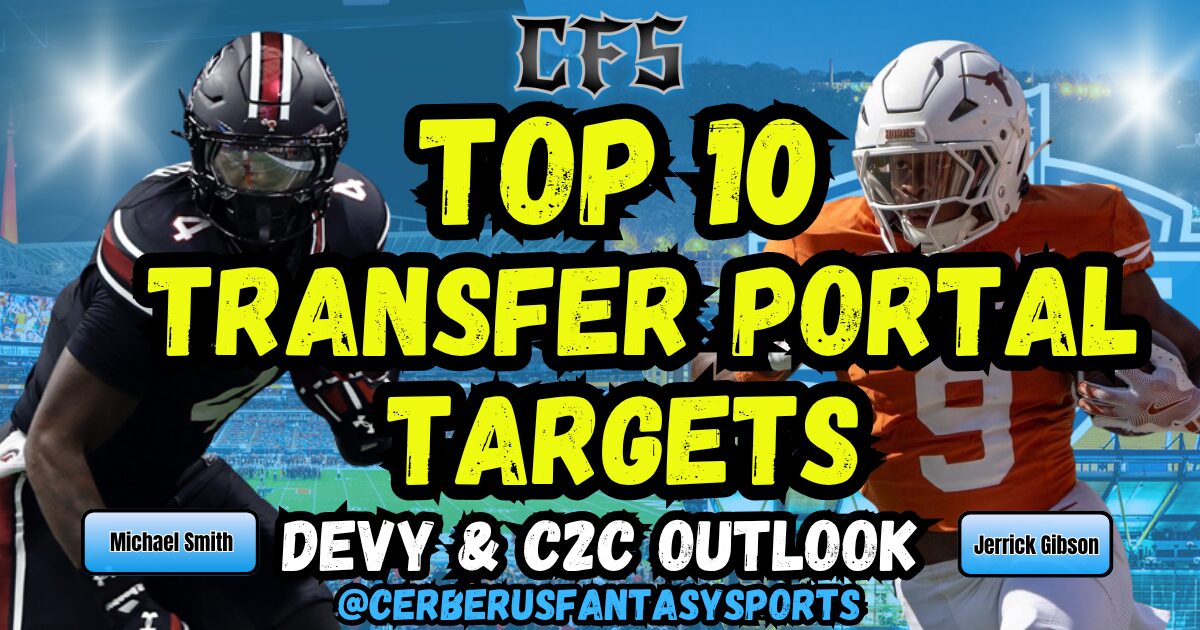
Top 10 Transfer Portal Targets (CFB Outlook)
College football’s transfer portal is no longer a safety valve, it’s the primary way programs remake rosters. For devy and C2C managers, that means the best bargains show up before landing spots turn them into household names.
This article profiles the Top-10 transfer portal targets to watch for 2026, why each player might move, where they could land, and how a new role would affect their devy/C2C value. Read this early and you’ll know which players to stash, trade for, or target in your next draft.
-
Michael Smith, TE, South Carolina
A former 4-star recruit and the No. 9 tight end in his class, Smith possesses the prototypical NFL frame (6’6″, 245 lbs) and athleticism that scouts covet. Despite starting seven games as a true freshman, Smith found himself buried on the depth chart in 2025, limited by injuries and, as Head Coach Shane Beamer stated, practice habits. By playing in only four games this season, he preserves a redshirt and will have multiple years of eligibility remaining.
The Outlook: Smith is a classic “buy-low” candidate. His physical tools are undeniable, but he needs a fresh start in a system that prioritizes the tight end in the passing game. Landing spots like Tennessee or Ole Miss, which have recently featured athletic tight ends as focal points, could unlock his significant NFL upside. He is a projectible talent in the same vein as Brock Bowersat Georgia, a player whose physical gifts simply need the right scheme to be fully realized. -
Makai Jackson, WR, Indiana
The Profile:Jackson is a proven producer at the FBS level, coming off an All-Sun Belt Third Team season at Appalachian State in 2024 where he amassed 745 receiving yards and five touchdowns.He transferred to Indiana seeking a bigger platform but was lost in a deep, talented receiver room. By appearing in only four games, he smartly uses the redshirt rule to reset.
The Outlook:Jackson isn’t a speculative talent; he’s a known commodity who needs volume. His path mirrors that of Jameson Williams, who was buried at Ohio State before transferring to Alabama and exploding into a first-round pick. Jackson needs to find a mid-tier Power 5 program with a pass-heavy offense and a clear need at outside receiver. If he does, he has immediate WR2/WR3 potential for your devy roster. -
Malik Elzy, WR, Illinois
Elzy was Illinois’ highest-rated recruit since 2019, a four-star prospect with an elite combination of size (6’2″, 225 lbs) and explosiveness.The production never matched the hype in Champaign. His agent called this a “strategic move to fully develop,” indicating a desire for a system that can better utilize his skillset.
The Outlook: Elzy is a high-risk, high-reward devy stash. The recruiting pedigree is real, and sometimes a change of scenery is all a player needs to put it together, similar to Michael Penix Jr., who found new life at Washington. He needs to land with a creative offensive coordinator who can design touches for him and a quarterback who will trust him in contested-catch situations. -
Jayden Gibson, WR, Oklahoma
Gibson is a massive boundary receiver (6’5″) who showcased elite downfield ability in 2023, averaging 26.7 yards per reception on 14 catches. His career has been derailed by a severe knee injury that cost him the entire 2024 season and has kept him sidelined in 2025. He is now no longer with the Sooners.
The Outlook: Gibson’s value is entirely destination-dependent. He is a field-stretcher who can be a red-zone nightmare, but he needs a quarterback who isn’t afraid to throw 50/50 balls. A move to a Big 12 or Pac-12 team with a young, aggressive quarterback could make him a star, much like Jordan Addison’smove to USC provided a perfect platform for his route-running prowess. -
Jerrick Gibson, RB, Texas
A highly-touted four-star recruit, Gibson showed promise as a true freshman but was caught in a logjam of elite talent in Texas’s backfield. With only 37 carries through six games, he chose to redshirt and seek a feature-back role elsewhere, preserving three years of eligibility.
The Outlook: Gibson is arguably the most enticing running back prospect likely to hit the portal. He has the three-down skillset to be a workhorse. His situation is reminiscent of Kenny McIntoshat Georgia, who bided his time before finally getting his chance to shine. Gibson should target a program with a clear need for a lead back, where he can immediately command 15+ touches per game and skyrocket his devy value. -
Josh Ford, TE, Oklahoma State
Ford is an experienced, in-line tight end who started multiple games for the Cowboys and has proven he can be a reliable safety valve. Ford’s entry into the portal was directly catalyzed by the firing of Head Coach Mike Gundy last month. He played only three games in 2025, securing his redshirt year and maintaining two or more years of eligibility.
The Outlook: Ford offers a safer, more immediate return than a project like Michael Smith. He is a ready-made starter who can step into a TE-friendly system and produce from day one. Think of him in a role similar to Brevyn Spann-Fordat Minnesota, a consistent, high-volume target who may not be a flashy athlete but is a quarterback’s best friend. -
Tucker Holloway, WR, Virginia Tech
Holloway’s value is two-fold: he’s a dynamic punt returner (All-ACC in 2023) with the speed to contribute as a slot receiver. The firing of Brent Pry opened a portal window, and Holloway is leveraging it to find an offense that will give him more opportunities as a receiver.
The Outlook: He is a specialist whose devy value hinges on a team viewing him as more than just a returner. If he lands at a school like Wisconsin or Nebraska—programs that have shown interest and need playmakers—and earns a dedicated slot role, he could provide sneaky PPR value, similar to how Jayden Reedwas utilized at Michigan State. -
Don Chaney Jr., RB, Charlotte
A former 4-star recruit to Miami, Chaney is a veteran, well-traveled back with over 1,000 career rushing yards and proven three-down capability. Now on his fourth team, Chaney is the ultimate “prove it” veteran looking for one final lead role.
The Outlook: While his journeyman status is a red flag, his pedigree and experience make him a compelling short-term target. He is a zero-risk devy flier who could pay immediate dividends if he wins a starting job at a G5 or lower-tier P5 program, offering a potential one-year workhorse profile akin to Xazavian Valladayafter his transfer to Arizona State. -
Bubba Hampton, WR, Alabama
Hampton is a former four-star athlete who has been buried on the depth chart in a perpetually talent-rich Alabama receiver room. He and the program mutually agreed to part ways after he left during fall camp; he has entered the portal in October and preserves three full years of eligibility.
The Outlook: Hampton is the quintificial “speculative add.” We haven’t seen much production, but the recruiting profile and the “Alabama bump” are real. He could follow the path of a player like Jermaine Burton, who transferred to Alabama and saw his profile rise, but in reverse, leaving Tuscaloosa for a place with a clearer path to targets could unlock his potential. -
Brayden Fowler-Nicolosi, QB, Colorado State
A experienced, gunslinging quarterback who has thrown for nearly 7,000 yards in his career, showcasing both high-volume potential and concerning turnover issues.The firing of Head Coach Jay Norvell in October, following a 2-5 start, directly prompted his departure. 1 He will look to start fresh after being benched during the 2025 season.
The Outlook: For superflex and 2QB devy leagues, Fowler-Nicolosi is a fascinating lottery ticket, though he has only one season of eligibility remaining. He has shown he can put up numbers in the right system. A transfer to a QB-friendly coach could help him cut down on the mistakes and maximize his arm talent, similar to how Bo Nix revitalized his career at Oregon by moving from a struggling Auburn offense to a scheme that perfectly highlighted his strengths.
Talent plus opportunity wins transfers, and for devy/C2C managers that formula is everything. Hunt for players with elite recruiting pedigrees, proven flashes of production, or a unique skill set, then back them if they land in a system that will actually use them. Stay ahead of landing-spot news and redshirt/eligibility moves, that’s where real value is created. In the transfer-portal era, the next league-winning devy asset is often just one smart move away.
- 🚀 Take the Next Step:
Join the Cerberus Playmakers Community and unlock:
-
Weekly Devy & C2C Rankings
-
Dynasty Value Reports
-
Insider Data Drops from the CFS Growth Tracker Tool
🎯 Join the Playbook Tier Now →
Be early. Be elite. Be Cerberus. 🐾