
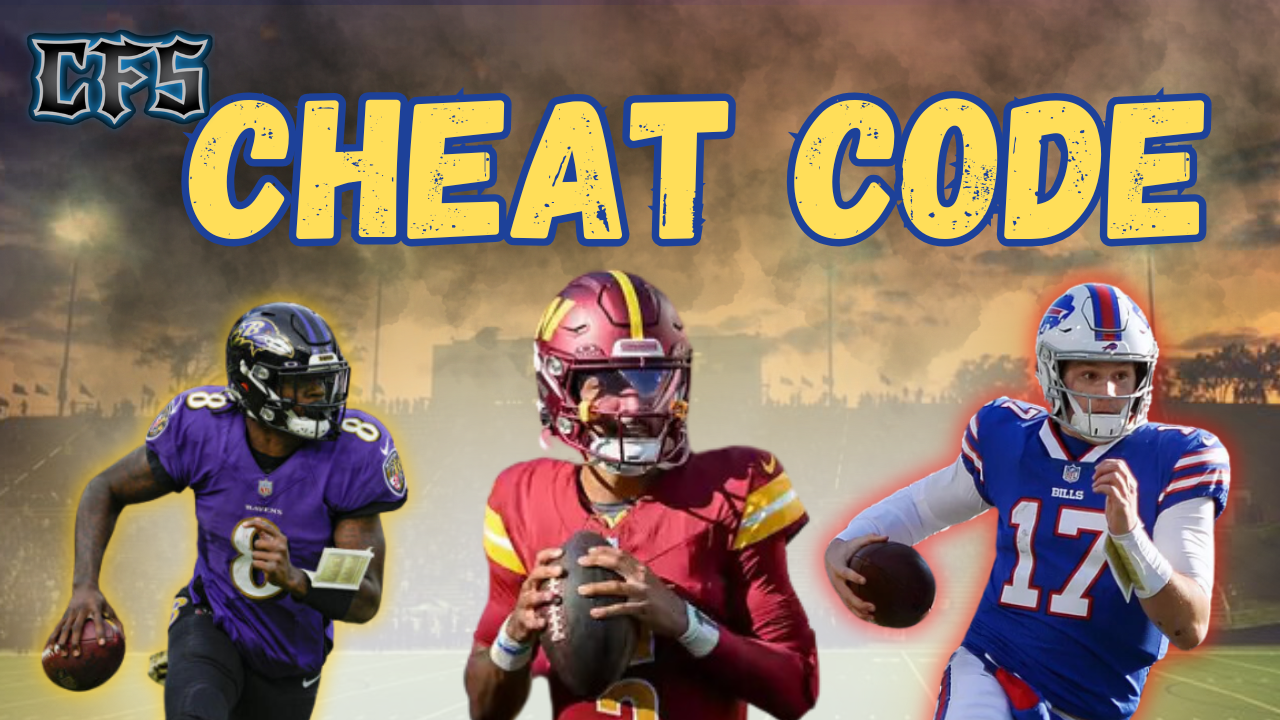
The NFL is rapidly changing as the years pass by. This is especially true when thinking about it in terms of fantasy football because everything is different now compared to ten years ago. Here we are going to discuss several different topics surrounding the new age of the NFL such as dual-threat quarterbacks becoming mainstream, positional groupings changing value, and analytics being a tool to guide game flow predictions.
Rise Of Dual Threat QBs
It is no secret that dual-threat quarterbacks are entering the NFL world more often than ever before. We’re getting to a point where immobile quarterbacks just aren’t heavily valued in the league as much as they used to be in years past. It’s just a new era of football upon us. With this change came a drastic change in fantasy football. Being able to draft a quarterback that can get you substantial value with his legs is crucial to success. For example, Lamar Jackson was able to give fantasy managers a boatload of fantasy points with his arm talent, yet he also rushed for over 900 yards and a couple of extra touchdowns to make him one of the best options at his position. The same can be said about Josh Allen, given that he’s just as talented through the air and on the ground. Hence, this is why these guys get drafted so highly in fantasy. You get the value of a quarterback with the extra points of a running back.
This should make you switch up your draft strategy just a little bit because it’s ten times better to target a dual-threat quarterback. Let’s say you get a guy like Derek Carr, who provides almost no value with his legs. He can throw four touchdowns, and still come away with fewer points than someone like Jackson. Why? Well, because Lamarr could throw only two touchdowns, but have an extra 85 rushing yards and a score on the ground on top of his passing yardage. And for someone like Lamarr, that’s just an average day for him while Carr would be having a wildly strong outing. This is just the difference between the two. Dual-threat quarterbacks can have an off-day and still provide enough rushing value to give you amazing points, while single-threat quarterbacks need to be great.
Shifts In Positional Value
Now, speaking of dual-threat quarterbacks, this also comes in line with the shifting of positional value. Someone like Jackson and Allen have helped push quarterbacks to a higher standing in terms of positional value, but if you aren’t able to get one of those top-tier players, most managers don’t value quarterbacks very highly anymore. These days, we see running backs held in high regard, getting taken off the draft board faster than you can recognize that they’re already gone. In the same sense, we’ve seen tight ends get forgotten entirely, with nobody really paying attention to the position group in the early rounds at all anymore like we used to.
It’s just common for the NFL to go through trends of certain position groupings performing better in fantasy, and managers adapting to those trends. It’s better to be ahead of that than behind it. Try to learn about the top fantasy performers for each position and see how they stack up against one another. You might realize that if you can’t get a top quarterback, then it is better to just wait and grab one of the premier receivers instead. You could also see that a middle-of-the-pack tight end might last until the later rounds due to the position group not being respected as much today. On the flip side, you can see a lower value running back get taken earlier than anticipated because so many others come flying off the board at lightning speed.
For right now, running backs are the position group that’s skyrocketed the most in value simply because there aren’t many number-one guys. These days it is very common to see NFL teams operate in a two-to-three-man committee in their backfield. Nobody wants to draft a guy that shares touches with three other players. So, the flat-out number-one backs get drafted super early so that the managers can reap the benefits of their absurd number of touches. Again, just keep an eye on how position groupings are thought of in fantasy football each year because this can go a long way to you winning a championship.
Using Analytics For Game Flow Predictions
Lastly, we need to spend some time talking about game flow predictions and analytics. There are always going to be analytics for how a team operates on any given week/season. Some teams prefer to pass the ball a lot, making all of their receivers more valuable in fantasy. Other teams operate heavily on the ground game, improving the value of their running backs. If you can look into a team’s preferences, you can get a better feel for who might have an increased opportunity in the season or week ahead. The downside is that it won’t always tell the full story. Some analytics make perfect sense on paper, but that team could then change up their strategy due to a matchup that they liked instead.
Analytics is a great tool to help you get a grasp on game flow, but you shouldn’t rely upon this as your only tool for success. Use is a resource to give you a further leg up along with the rest of your fantasy football knowledge. Game flow can change at a rapid speed. You could see a matchup between the Buffalo Bills and Detroit Lions and think that this game will be a high-scoring shootout with a ton of passing. Then, the game comes, and the score can be 21-20 with a heavy emphasis on the ground game. The NFL is unpredictable, so analytics can be off despite you doing everything correctly. It’s just important to note that it shouldn’t be the entire strategy, but a part of it.