
Don’t have time to read?
Press play and get the full Biggest Dynasty Fantasy Football Mistakes Before Week 1 in under 5 minutes.
The Biggest Dynasty Mistakes Fantasy Managers Make Before Week 1
August can be one of the most dangerous periods for dynasty managers.
Training camp reports arrive daily. Injuries move player prices. Preseason touchdowns create new sleepers overnight. Because dynasty decisions can affect a roster for years, reacting quickly is not always the same as reacting correctly.
As of August 15, 2026, the key is not to ignore preseason news. It is to separate long-term signal from short-term noise.
What Are the Biggest Dynasty Mistakes Before Week 1?
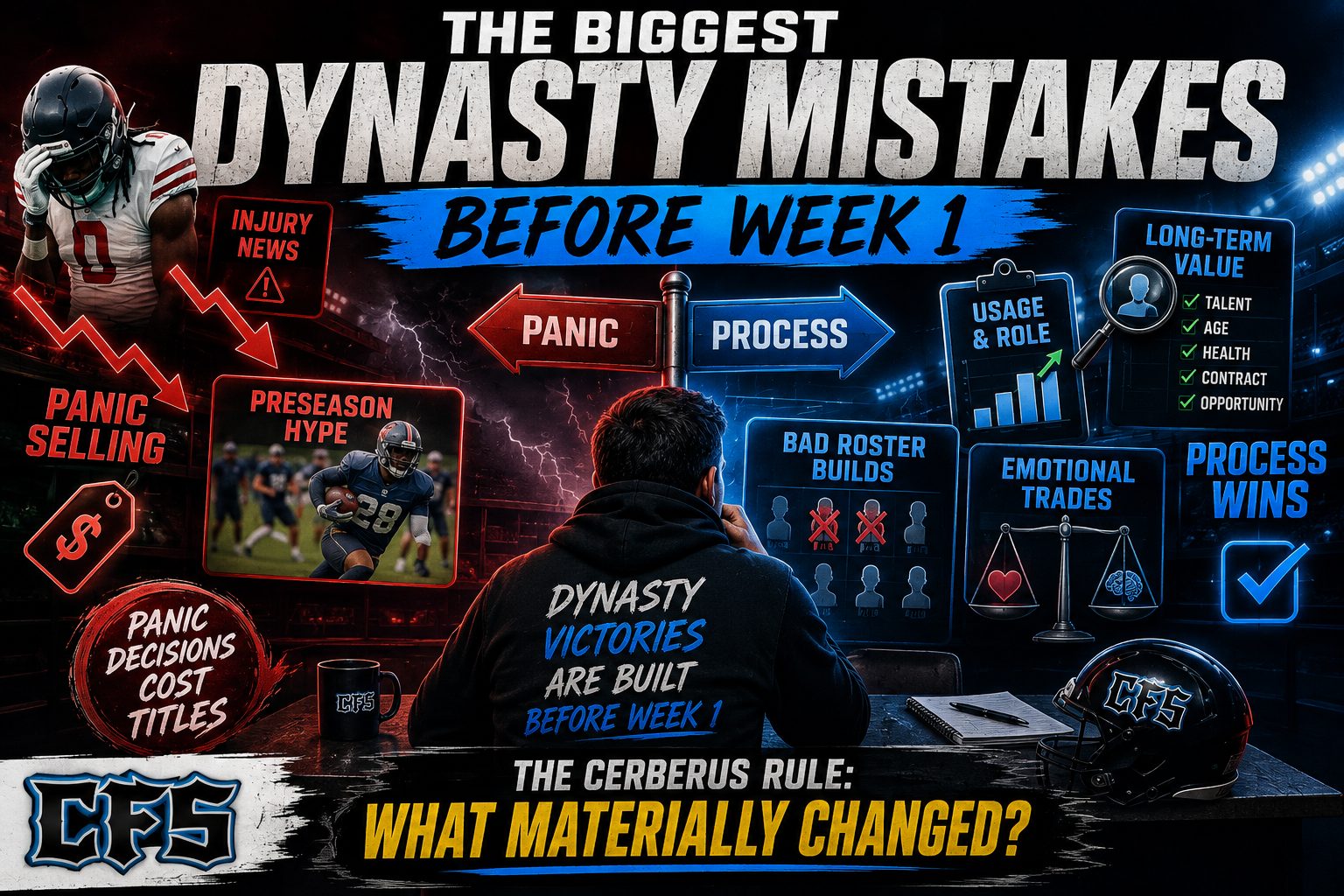
The biggest dynasty fantasy football mistakes before Week 1 are panic selling after negative news, overvaluing preseason performance, poor roster construction, and making emotional trades.
Good dynasty managers ask one question before changing a player’s value:
What materially changed?
1. Panic Selling Because of Bad August News
Panic selling happens when short-term uncertainty causes you to accept a permanent dynasty discount.
The key is separating price-changing information from emotion-changing information.
Luther Burden III is a useful 2026 example. He is expected to miss the preseason with a groin injury, but Chicago reportedly expects him to be ready for the regular-season opener. Reuters’ report on Luther Burden’s injury shows why missing exhibition games should not automatically trigger a major dynasty downgrade.
Ricky Pearsall’s situation is fundamentally different. He requires surgery for a torn PCL and will miss the 2026 season, according to Reuters’ report on Pearsall’s season-ending injury. That removes an entire season of production and creates a much larger change in his dynasty outlook.
This is why managers should avoid the type of dynasty trade traps that make selling high backfire. A scary headline does not automatically mean a player’s long-term value has collapsed. Cerberus’ existing trade-strategy coverage similarly emphasizes evaluating role and sustainable value instead of reacting emotionally.
What to Do Instead
Before selling an injured dynasty asset, ask:
- What is the diagnosis and return timetable?
- Does this change the player’s long-term role?
- Is there meaningful recurrence risk?
- Has the market fallen more than the actual outlook?
- Would I accept this trade without today’s negative headline?
Sell when the forward-looking thesis changes, not when your comfort level changes.
2. Overvaluing Preseason Performance
Preseason matters. Preseason box scores matter much less.
A backup running back can break a long touchdown against third-string defenders. A rookie receiver can score twice on four targets. Neither automatically deserves a major dynasty value increase.
PFF’s research on whether preseason performance translates for rookies provides an important warning. Among 45 rookies who earned an 80.0-plus preseason PFF grade in 2025 on at least 25 snaps, only one later recorded a 70.0-plus regular-season grade over at least 250 snaps. The sample includes offensive and defensive players, so it should not be treated as a fantasy-specific forecasting model.
August hype can distort market prices in the same way combine hype does. Our breakdown of why rookie ADP can mislead dynasty managers explains how narratives, athletic flashes and perceived upside can move players faster than their underlying fantasy outlook.
Watch Usage Instead of Highlights
First-team snaps: Is the player actually earning work with projected starters?
Route participation: Is a receiver running routes when the starting quarterback drops back?
High-value RB touches: Watch targets, passing-down work, two-minute snaps and goal-line opportunities.
Personnel usage: Does the player stay on the field in formations likely to be used during meaningful games?
PFF’s guide to what fantasy managers should watch during preseason specifically highlights starter usage and running back rotations as useful indicators.
The best dynasty preseason strategy is simple: use preseason to update role probabilities, not project 17 games from tiny samples.
3. Building the Wrong Type of Dynasty Roster
Good dynasty roster construction is not about making every position look balanced.
Your roster should match your league settings and competitive window.
Superflex provides the clearest example. Current RotoWire dynasty superflex rankings have Josh Allen and Drake Maye first and second overall, showing how dramatically quarterback scarcity changes valuations compared with 1QB formats.
Your roster timeline matters just as much.
Contenders Need Points and Protection
A real contender needs reliable weekly starters, injury protection and bench players with clear paths to useful production.
Do not become so focused on preserving youth and future picks that one injury can destroy your championship lineup.
Understanding age cliffs and dynasty value windows can also help contenders decide when immediate production is worth more than long-term asset preservation.
Rebuilders Need Value Growth
A rebuilding team should prioritize young assets, future picks, liquidity and players whose roles or market values can increase.
Loading a rebuild with veteran running backs whose biggest strength is immediate production can leave that value declining before you are ready to contend.
Cerberus’ rebuilding dynasty trade strategy follows the same basic principle: rebuilding managers should convert short-term production into assets that better fit their longer competitive window.
4. Letting Emotion Decide Dynasty Trades
The final mistake connects the other three: emotional decision-making.
August creates perfect conditions for recency bias. A nationally televised touchdown is vivid. A dropped pass is memorable. An injury notification creates urgency.
Managers can also become anchored to what they originally paid for a player. But dynasty value should be based on expected future value, not acquisition cost.
Use the Five-Question Dynasty Trade Test
Before any meaningful trade, ask:
- What did I believe about this player one week ago?
- What genuinely new information arrived?
- Which part of my projection changed?
- Does that change last days, one season or multiple seasons?
- Would I make the same trade if I owned the other side?
The same discipline applies during drafts. A good fantasy football draft trade strategy treats the draft room as a changing market instead of blindly following static rankings or reacting to positional runs.
If you cannot clearly explain what changed, you probably do not need to change your valuation.
Pre-Week 1 Dynasty Checklist
Before accepting a trade, cutting a player or chasing a preseason riser:
- Identify the trigger. What caused you to consider the move?
- Classify the timeline. Is the effect temporary or multi-year?
- Check usage. Review first-team snaps, routes and high-value touches.
- Check fundamentals. Age, draft capital, health, contract and role still matter.
- Check your window. Are you contending, rebuilding or somewhere in between?
- Check the market. Compare rankings, ADP and actual league offers.
- Reverse the trade. Would you still make it from the other manager’s side?
Before Week 1, do not ask only “What happened?”
Ask “What changed, and did it change enough to justify this price?”
Frequently Asked Questions
What is the biggest dynasty fantasy football mistake before Week 1?
The biggest mistake is overreacting to short-term information. Minor injuries, preseason touchdowns and camp reports can move sentiment without changing a player’s multi-year outlook. React most strongly when health prognosis, role, opportunity or long-term value materially changes.
How much should preseason matter in dynasty fantasy football?
Preseason matters primarily for usage and role evaluation. First-team snaps, route participation, third-down work, goal-line usage and personnel deployment usually provide more actionable information than exhibition touchdowns or raw yardage.
Should I trade an injured dynasty player before Week 1?
Not automatically. Evaluate diagnosis, timetable, recurrence risk, role impact and current market price. Missing preseason games is very different from an injury requiring season-ending surgery.
Is dynasty ADP the same as player value?
No. Dynasty ADP is a market reference, not objective fair value. FantasyPros’ 2026 dynasty ADP data currently identifies Sleeper as its single overall dynasty ADP source, another reason managers should compare multiple rankings and actual league trade demand.
How should I build dynasty bench depth before Week 1?
Prioritize players who provide either injury protection or meaningful upside. Backup running backs with clear paths to larger workloads can be especially valuable in deep leagues. Cerberus’ RB handcuff strategy guide explains why dynasty’s deeper benches make these contingency assets more useful than they are in shallow formats.
When should I buy low on a dynasty player?
A dynasty buy-low makes sense when market fear has fallen faster than the player’s long-term outlook. Temporary injuries, missed preseason games and short-term uncertainty can create opportunities when the underlying talent, role and multi-year thesis remain intact.
3 thoughts on “Biggest Dynasty Fantasy Football Mistakes Before Week 1”