
Don’t have time to read?
Press play and get the full How Smart Fantasy Managers Build Championship Bench Depth in under 5 minutes.
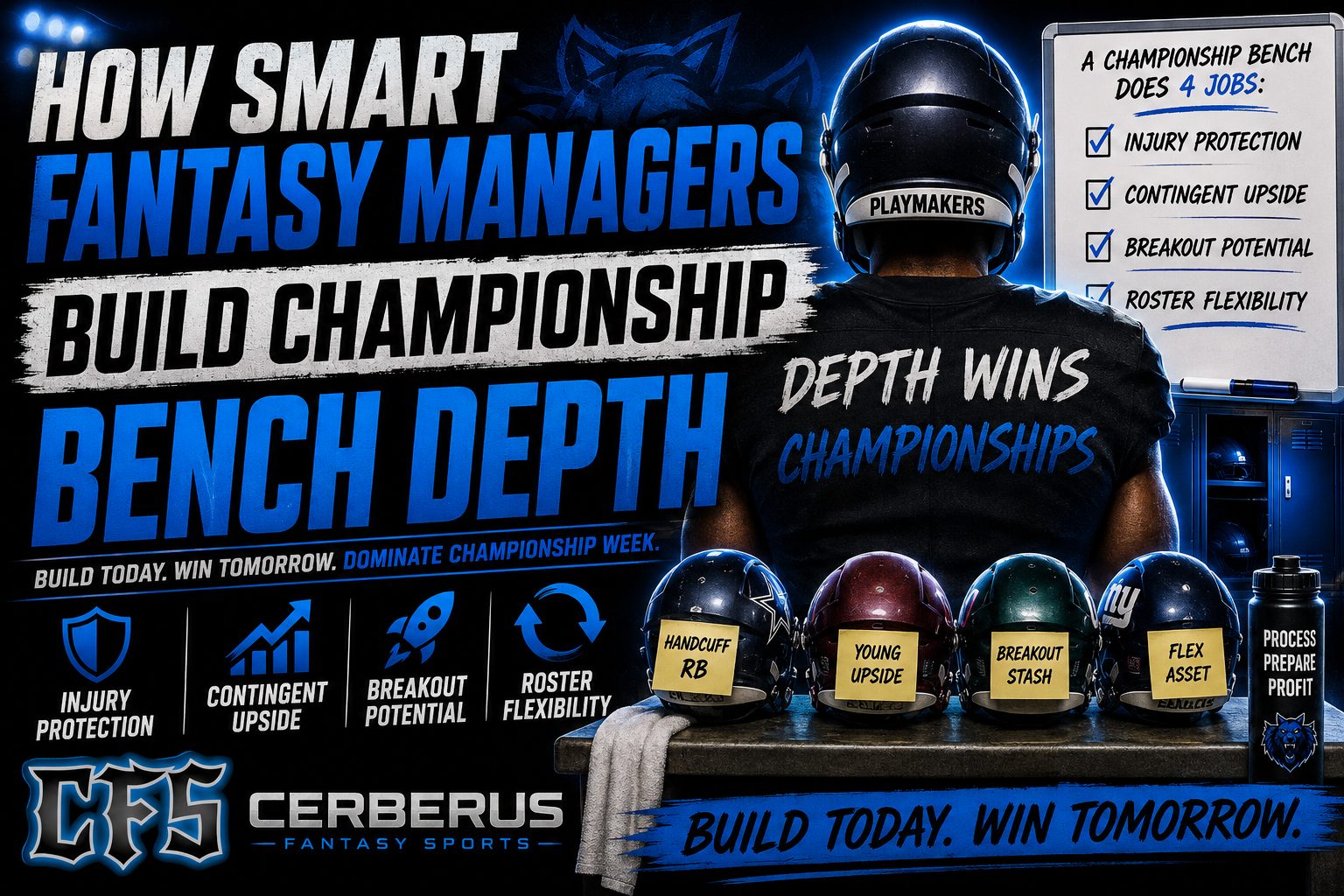
How Smart Fantasy Managers Build Championship Bench Depth
As of August 10, 2026, a strong starting lineup can make a dynasty team a contender, but championship bench depth helps it survive injuries, bye weeks, and role changes. Smart managers build the bench around players who can become starters, gain trade value, protect key assets, or create flexibility.
In August, prioritize upside and optionality. During the season, react quickly to usage. Near the fantasy playoffs, shift more bench space toward injury protection and immediate startability.
Build Your Dynasty Bench Around Four Jobs
Every bench player should ideally serve at least one of four purposes:
- Injury protection: A backup who can replace an important starter.
- Contingent upside: A player whose fantasy value could spike after one depth-chart change.
- Breakout potential: A young player gaining snaps, routes, touches, or a larger offensive role.
- Roster flexibility: A player who can cover multiple lineup problems or be moved quickly for value.
Avoid carrying too many low-ceiling veterans who provide similar production with little chance of becoming difference-makers. In most 1QB dynasty leagues, RBs and WRs should occupy most ordinary bench spots. Superflex requires more quarterback insulation, while TE depth depends on league size and scoring.
Bench construction should reflect replacement cost, lineup requirements, asset value, and your competitive window. That portfolio approach also matters when deciding which players to hold or move as they approach different dynasty age cliffs and trade windows.
Use Contingency Planning Instead of Collecting Backups
A championship bench should answer one question before the season starts:
What happens if one of my core starters disappears tomorrow?
That is contingency planning.
Running back is the easiest position to apply it because backup RBs can inherit usable volume almost overnight. RotoWire’s 2026 handcuff running back tiers place TreVeyon Henderson, Rico Dowdle, Blake Corum, and Kyle Monangai in a top group because they combine some standalone value with much greater upside if circumstances change.
That is the profile to chase. Do not ask only, “Who backs up my RB1?” Ask:
How much work would this player inherit, how good is the offense, does he already have a role, and what does he cost?
Blake Corum is a useful example. He played 29.25% of the Rams’ offensive snaps in 2025, so his value is not based entirely on speculation. If his workload expands, the fantasy payoff can arrive quickly.
For a deeper look at when to roster your own backup versus another manager’s contingency player, see our fantasy football handcuff strategy.
Early in the season, rostering another manager’s premium handcuff can create more upside because an injury could give you a new starter without weakening your lineup. Near the playoffs, direct insurance for your own elite running backs becomes more important.
Build Positional Insulation Where Scarcity Hurts Most
Positional insulation means having enough depth to survive realistic problems without wasting roster spots.
At running back, prioritize direct workload paths. At wide receiver, focus more on talent and route growth because targets are often redistributed when one receiver is injured. At tight end, roster a second option when the waiver pool is thin or a young TE has a realistic path to more routes.
Quarterback strategy changes sharply by format. In 1QB dynasty, multiple low-upside backup quarterbacks can clog the bench. In superflex, a competent NFL QB2 can become a major trade asset after one injury or benching.
Injuries remain unpredictable even when league-wide trends improve. The NFL reported that ACL tears fell 25% during the 2025 regular season, while the overall lower-extremity injury rate remained steady. That still gives fantasy managers a reason to build depth because missed games cannot be predicted reliably. See the NFL’s 2025 injury data takeaways.
Target Upside Stashes Before the Box Score Breaks Out
The best dynasty bench stashes are players who sit near an information cliff. One injury, promotion, or role change could reprice them quickly.
At running back, look for players one step away from meaningful volume. PFF’s 2026 running back sleepers highlight Jonathon Brooks as a player with a path to a much larger role if healthy. The broader lesson matters more than one name: target backs who could become weekly starters if their opportunity changes.
For wide receivers and tight ends, routes and first-team involvement matter more than preseason receiving yards. A young receiver playing regularly with starters but producing a quiet stat line can be a better dynasty stash than a reserve who scores twice against third-string defenders.
Track these breakout signals:
- RB: carries with starters, passing-down work, goal-line usage, pass protection
- WR: route participation, first-team snaps, target share, two-minute usage
- TE: routes per dropback, slot usage, red-zone involvement
- QB: depth-chart position, starting opportunities, rushing ability, team commitment
This is the same principle behind identifying waiver-wire players with league-winning upside: focus on changing roles and usage before chasing last week’s fantasy points.
Smart managers try to acquire the role increase before fantasy production makes it obvious.
Keep One Bench Spot Flexible
One of the biggest advantages in dynasty is the ability to react before league mates.
Do not become emotionally attached to the last player on your roster. The bottom few bench spots should be compared constantly against available free agents and emerging depth-chart winners.
This becomes especially important around NFL roster cuts. According to the NFL’s 2026 important dates, teams must reduce their active rosters to 53 players by August 30, 2026. That creates an important information reset as depth charts and practice squads become clearer.
During Weeks 1 through 4, aggressively reassess preseason stashes. If the expected role never appears, move on. Dynasty rewards patience with elite prospects, but patience should not become roster paralysis for replaceable players.
A periodic dynasty lineup audit can also help identify whether your depth actually supports a championship run or simply looks deep because the roster contains familiar names.
Shift From Upside to Survival Before the Fantasy Playoffs
A contender’s bench should look different in December than it did in September.
Early in the season, the goal is asset creation. Late in the season, the goal becomes lineup survival.
Start your playoff bench audit around Weeks 12 through 14. Identify your most fragile starters and secure realistic replacement options before an injury forces you into an expensive waiver claim or trade.
The 2026 bye schedule makes preparation important. NFL byes run from Week 5 through Week 14, with six teams off in Week 11. Arizona and Dallas have the final byes in Week 14. Review the full 2026 NFL bye-week schedule before cutting usable depth.
You can also use Cerberus’ bye-week planning strategy to identify roster problems before they force reactive waiver moves.
For a true contender, the final playoff bench should emphasize:
- Direct RB handcuffs for cornerstone starters
- At least one dependable emergency starter at thin positions
- Appropriate QB protection in superflex
- High-value young assets that are too valuable to cut
- Fewer long-shot projects with no near-term role
A championship bench is not necessarily the deepest roster on paper. It has the most useful paths to winning when circumstances change.
Final Takeaway
The smartest dynasty managers treat bench depth as an evolving strategy, not a preseason checklist.
Build for optionality in August. Chase role growth during the season. Protect scarce positions. Churn replaceable roster spots. Then trade some long-term uncertainty for direct playoff insurance when a championship is within reach.
That combination of contingency planning, positional insulation, breakout stashes, roster flexibility, and playoff preparation is what turns a strong dynasty roster into one built to survive a title run.
Frequently Asked Questions
How many bench spots should I use on running backs in dynasty fantasy football?
There is no universal number because league size and roster settings differ. As a general strategy, running backs deserve a large share of marginal bench spots because backup RBs can gain fantasy value quickly when injuries or depth-chart changes create touches.
Should I handcuff my own running backs in dynasty?
Not automatically. Early in the season, the highest-upside backup may belong to another manager’s starter. As the fantasy playoffs approach, directly handcuffing your own elite RB becomes more valuable because protecting an established championship lineup matters more than maximizing variance.
What positions should I prioritize on a dynasty bench?
In 1QB leagues, prioritize RB and WR upside, then add TE or QB depth when replacement options are scarce. In superflex, reserve quarterbacks become much more important because a new NFL starter can immediately gain lineup and trade value.
What makes a good dynasty breakout stash?
A good stash combines talent with a realistic path to more opportunity. Look for young players gaining first-team snaps, routes, touches, goal-line work, or depth-chart position. Role growth is usually more actionable than one big preseason box score.
How should taxi squads be used in dynasty leagues?
Use taxi slots for young players with long-term upside who are unlikely to help your active lineup immediately. On Sleeper, taxi squads can contain 0 to 10 slots, with experience eligibility and deadlines controlled by league settings. See Sleeper’s taxi squad rules.
How should I prepare my fantasy bench for the playoffs?
Begin before the playoffs start. Replace low-probability projects with direct injury contingencies and players you could actually start. Cerberus’ guide to playoff stashes, trades, and schedules provides a useful framework for making that transition.
Use every legal IR slot efficiently, but monitor eligibility because a player can lose IR eligibility when his official injury designation changes. Sleeper explains its IR eligibility rules.
One thought on “Dynasty Fantasy Football Bench Strategy: Build Championship Depth”