
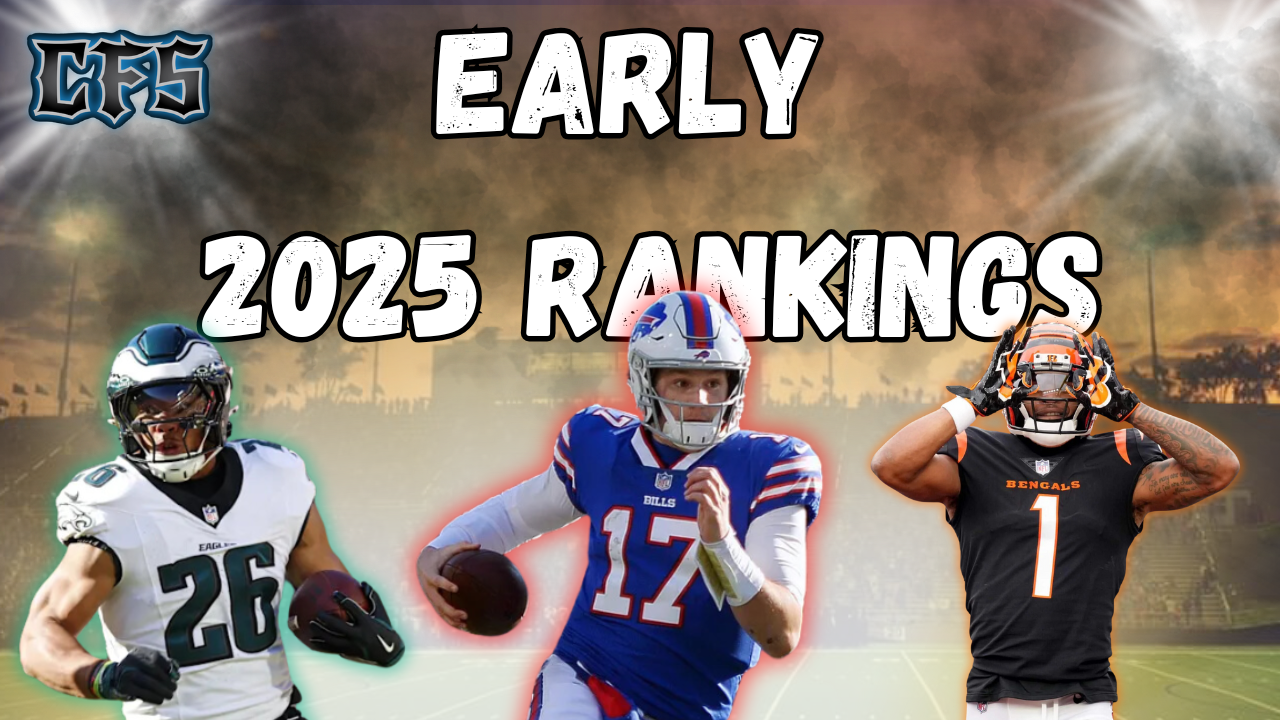
The fantasy football season has officially come to an end, which means all of us fantasy managers need to prepare for the next run at a championship. Even those managers who are high off a blissful championship run will need to get themselves ready to do it all over again soon. Below we are going to dive into the upcoming 2025 fantasy football season, talking about a few rankings, projection metrics, and thoughts on strategic lineup integration.
Player Rankings
Let’s start with quarterbacks. Looking ahead, there appear to be three signal callers who will be valued higher than anybody else. Josh Allen, Lamar Jackson, and Jayden Daniels. Now, what do these three players have in common to get them ranked so highly? They are all excellent athletes who make plays happen consistently with their legs. That combined with their passing abilities put them far above the rest of the competition.
As for the running backs, Saquon Barkley is prepared to lead the charge once more, now that he’s finally behind a strong offensive line with the Philadelphia Eagles. Jahmyr Gibbs trails closely behind him, with his explosiveness and situation also ringing like Saquon’s. Gibbs does have to work alongside David Montgomery, but with the way the Detroit Lions score, Gibbs remains atop the rankings anyway. We also can’t forget about Bijan Robinson. Some might have thought that he had a slow year in 2024, but he was still performing extremely well from a fantasy perspective. These three are as consistent as it gets.
Diving into receivers is quite easy. Ja’Marr Chase is right at the top. The most recent winner of the Triple Crown, Chase has thrived each season in the league alongside Joe Burrow in this high-powered Cincinnati Bengals offense. Justin Jefferson is right next to him, putting up unbelievable receiving numbers despite switching quarterbacks from Kirk Cousins to Sam Darnold. Even if his quarterback changes once more, he’s proven to be reliable. Then there’s Amon-Ra St. Brown, someone who can score every game. He had scored a touchdown in eight straight games this season, and that is all that needs to be said.
When getting into the tight ends, this gets a little interesting. I love what Trey McBride brings to the Arizona Cardinals and have to feature him atop the rankings. McBride had 111 receptions for 1,146 yards this season. Those were the fourth-most receptions in the league and the 11th-most receiving yards, for a tight end. That doesn’t come easy. Brock Bowers is right there with him after a phenomenal rookie season in which he posted great numbers despite having Gardner Minshew, Desmond Ridder, and Aidan O’Connell throwing the football to him. And lastly, I want to mention George Kittle. As a beacon of consistency over the years, Kittle steadily passed the 40-receiving-yard mark in almost every single game this season. Tight ends might be hard to come by in fantasy, but these three are as good as it gets.
Projected Performance Metrics
Projected performance metrics are useful, but it needs to be memorized that they are strictly projections, nothing more. They are meant to guide you and act as a solid estimation of how a player might perform throughout the course of the season or in any individual game. However, these projections can be very far off due to situations that are beyond their control. For example, you might see a player’s overall performance projected to lead their position by the end of the season. Fast forward, and you see that they wind up finishing 18th. You might feel wronged by the projection, but in reality, that player could have missed games, gone through team turmoil, or was on a team that was never in a position to get them the ball consistently.
With all of that being said, projections do give a solid sense of what a player’s situation is looking like heading into the season. Most of these metrics try to take into account everything, from the offense that they are a part of, to the number of touches they usually get per game. It is all factored into the projection carefully. Now, for receivers and tight ends, things can change much quicker due to them needing to rely upon a quarterback. They could be the best talent in the world, and be projected a ton of points, yet watch those projections plummet because they had a quarterback change. It’s not a slight to their talent, but rather the circumstances.
Strategic Lineup Integration
At the end of the day, all that matters is how you handle your lineup integration. Some fantasy managers prefer to simply set their lineups with which players are projected the highest number of points in any given week. That is definitely a strategy that can work for you, though again, this isn’t a guaranteed method of success. Neither is taking the time to perfectly craft and maneuver your lineup to get it all 100 percent correct. Mistakes are going to be made throughout the season, that’s definite. What is more important is how you go about strategizing your lineups. Many managers prefer to integrate their lineups based on matchups, trying to get a vision of how an upcoming game might go.
The overall majority of managers attempt to be consistent in the way that they judge these lineup choices. It is worth noting that it’s hard to make these choices based only on logic. There will be instances where you fall in love with a player and trust them regardless of the matchup ahead, or you have grown to distrust another so heavily to the point where you won’t start them no matter who they face. This can happen, and it allows you to become more involved, though remember that every week is a new opportunity. Remember the past, but don’t judge the future solely off of it. Everyone will have different ways of integrating their lineups, just try and do so in a way that works for you every week.