
Introduction
You’re in a Campus to Canton league and you might be concerned about roster management. Fear not, as we are going to be diving deep into what roster management entails, including how important it is for your long-term and short-term success in the league. By the end of this, you’ll know how to set your lineups, target players on the waiver wire, and balance your goals for both leagues without getting overwhelmed.
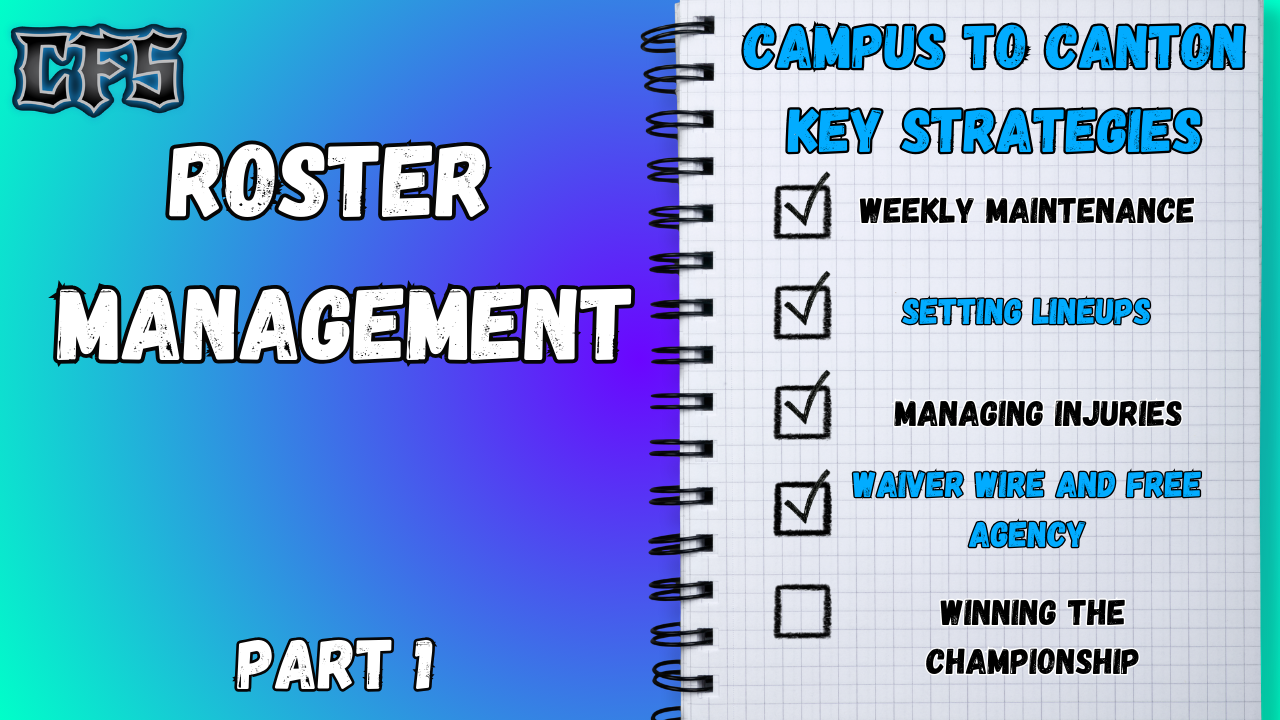
Weekly Maintenance
It’s not easy to be successful in a Campus to Canton fantasy league when you aren’t willing to put in the work on a weekly basis. Weekly maintenance in one of these types of leagues can take place in a variety of different forms, but we’ll start with setting your lineups.
Setting Lineups
It will be incredibly difficult to win your league if you aren’t paying attention to the lineups that you’re setting each week. This is why you should take a little bit of time each week, and double-check before game day, to ensure that the lineup you’re sending out there is as good as it can be. This means that you sub out anybody that isn’t going to be playing in a specific week and place the players that you think would perform the best against their upcoming matchups.
Tips For Optimizing Your Starting Lineup Each Week
As for tips, one of the best ones that I could give when talking about optimizing your starting lineup is to pay attention to your matchups. Keep an eye on the players that you currently have across your roster, and don’t be afraid to make a small change if a player on your bench has an incredible upcoming matchup. It isn’t always wise to substitute only on the basis of matchups, but thinking this way could be a good move every once in a while. Another tip would be to check every other day. In college football, players are ruled out every single day. And in the NFL, players have their injury reports and status updated throughout the week. Keeping an eye on both lineups every other day ensures that you’re always up to date and can keep switching the roster up, if necessary, to avoid having empty spaces.
Importance Of Matchups And Current Form
Now, doubling down on the talk of matchups, there are certain players that are the best of the best. These top-tier players are usually going to remain in your starting lineup regardless. However, the rest of your roster will likely have players that you feel comfortable benching from time to time. With these players, it can be a good idea to bench one if they happen to be going up against the toughest defense in the league this week. Maybe you have someone on the bench in the same position who’s competing against the softest defense in the league at the same time, so swapping them for one another wouldn’t be a bad play. Matchups can oftentimes be a good indicator of a great week.
Managing Injuries
The one thing you can’t often prepare for is injuries. There is nothing you can do about it; injuries are just a part of the game. They can come at any time, including game day, and there will be instances where there’s nothing left to do but take a zero in your lineup if they exit a game early on.
Strategies For Dealing With Injured Players
The best strategy that you can have when dealing with injured players is to always have a backup option. You never want to have only two running backs on your roster, because if one goes down, you’re left with no other options. Keep a few backups and check your lineups to prepare for these injuries. When they inevitably happen, what you can do is add the player to an injured reserve spot if your league opts to include that. This frees a roster spot for you and doesn’t force you to drop the player. Speaking of, try to avoid dropping the player from your roster immediately until you are certain of the injury. Absorb all of the information you can about your injured players and take your time when coming to decisions about them.
Importance of Depth And Flexibility In Your Roster
I briefly mentioned this earlier, but there is nothing more important on our roster than depth or flexibility. When you have a team that has multiple options spread across your bench, you will always have a leg up above the competition. Again, injuries happen all the time, and they can hit certain fantasy managers harder than others. If you’re the only one who’s prepared with a deep roster of bench options, then you can always send out a solid lineup. Other managers wouldn’t be able to do that if they lost players of their own to injuries. This depth helps you with injuries, bye weeks, absences, and when your starters are going on a bit of a dry spell.
Waiver Wire And Free Agency
Next, it’s time to manage your roster following some waiver wire pickups and free agency. These are two of the most important things that a fantasy manager can take advantage of throughout the year, so it’s best to learn how to manage your roster successfully.
Waiver Wire Strategy
Everybody is going to have a different waiver wire strategy. Some people prefer to stick with the lineup that they started the season with unless they are really enticed by a free agent. Others want to make as many moves as possible throughout the week to bolster their group with the hottest new additions. Whatever the case may be, you need to stick with a strategy that supports your current team. If you need help at a certain position, spend some time attacking the waiver wire to bolster that spot. Don’t just pick up random players that might be interesting for a given week because they’re a hot name. Remember, it is okay to miss out on a waiver wire target every once in a while, to avoid falling into roster troubles down the line.
How To Prioritize And Bid For Waiver Wire Pickups
Now, there will be weeks when you have multiple waiver wire targets that you want to acquire. How do you manage all of those targets? Well, for starters, prioritize the ones that you want the most, and who can help impact your fantasy success. You can rank them internally to decide who the most valuable are, and then later go after them first. If you are able to get the main pickups that you wanted on a specific week and you still have some roster flexibility to work with, then go back and try to get one of the other targets on your list. Setting up limits for how many players you are going to add on a given week and ranking the targeted waiver wire pickups can be a great way to manage your roster.
Tips For Identifying High-Upside Players
How can you find players that have high upside? There are a few ways. If you’re studying film, the one thing that will always stand out with high-upside players is effort, particularly blocking and hustle. These two things can help a player get on the field more, which immediately boosts their stock in fantasy leagues. Another tip for identifying these high-upside players is the situation. It doesn’t matter if they’re in college or in the NFL, you can identify high-upside players if it appears like they’re knocking on the door of a starting job soon. Again, more opportunities, and more potential for them to succeed at either level.
Free Agency Moves
When a season ends, you will normally have free agency available, though it depends on how your specific league decides to set it up. Free agency can oftentimes be first come first serve on players during the offseason and is usually where you’ll see many fantasy managers get aggressive to try and fill out their depth.
Importance Of Staying Active in Free Agency
The reason why you should always stay active in free agency is because you never know who might be available. As I said earlier, many other fantasy managers tend to get active at this same time, so there will be new players getting dropped that you might not have expected prior. Keeping an eye on things and filling your depth through free agency can help prepare you for tough situations during the season.
How To Use Free Agency To Address Team Needs
Free agency works very similarly to the waiver wire, except this is technically during the offseason. When you’re looking to address your team’s needs, the way to do so is pretty simple. You want to sort the available players by position, and simply go down the list looking at your options until you find a player that might help you both long-term and short-term. Then, go after them and put a claim in.
Long-Term Planning
Speaking of long-term planning, you shouldn’t forget to prepare yourself for the future as well as remain competitive in the present day. Never ignore one of those options for the other.
Balancing Short-Term And Long-Term Goals
Campus to Canton leagues require a significant amount of balance overall. You want to try and win your league every single season, but you don’t want to sacrifice the future of your team to win one singular time in the present day. This is why you want to focus on players that help you win immediately, while not ignoring the players that can help you win in the future, even if they aren’t producing at the moment. Many fantasy managers struggle with this more than anything else. This fear causes them to sacrifice depth to try and win a championship immediately, which oftentimes doesn’t work in their favor. Others get so caught up with competing down the line that they sacrifice multiple years to try and build a youthful championship roster in the future, which could also take too long to pan out. Balance, that’s the name of the game in a Campus to Canton league.
Strategies For Managing Both College And NFL Rosters
There are so many strategies to give for managing both rosters, though the best would be to set out time to manage both of them. You want to spend an equal amount of time checking over your college and NFL roster. This means going through available waiver wire targets, setting your lineups, and scouting potential high-upside talent for the draft. Perhaps you could set out ten minutes per day to check both leagues out and get a feel for everything that is going on in both of them. Just try not to spend an abundance of time in one league, while forgetting about even checking the other.
Tips For Ensuring Long-Term Success While Competing In The Present
A great tip to ensure long-term success while competing in the present day would be to find youthful players who put up numbers in both leagues. You want to get younger players who are starters straight away to be able to compete for a championship in the present, and you’ll know that they’ll be there for you in a few years to help you succeed long-term. Another strategy to ensure long-term success would be to consistently remain active in free agency and during the waiver wire to acquire high-upside players. These will help you down the line, and you likely won’t need to sacrifice your best players on your current roster to acquire them, as you would in the event of a trade.
Conclusion
Roster management can’t be understated when looking at a Campus to Canton league. You have two rosters to manage throughout the season, two waiver wire sections, and two free-agency periods. All of this can get very overwhelming and confusing, but the aforementioned strategies are designed to provide some help. Remember, roster management gets significantly easier when you start breaking things down and providing an equal amount of time to each league.